Before making a selection, users need to have a basic understanding of the basic requirements of LED grow lights:
Spectrum: LED grow lights mimic natural light, but unless they are full spectrum LED lights, they may not have all the colors on the electromagnetic spectrum (such as a special ratio of red and blue). If users grow cannabis plants from seed to flower, they should be looking for a combination of blue, violet (UV), red and infrared (IR) LEDs.
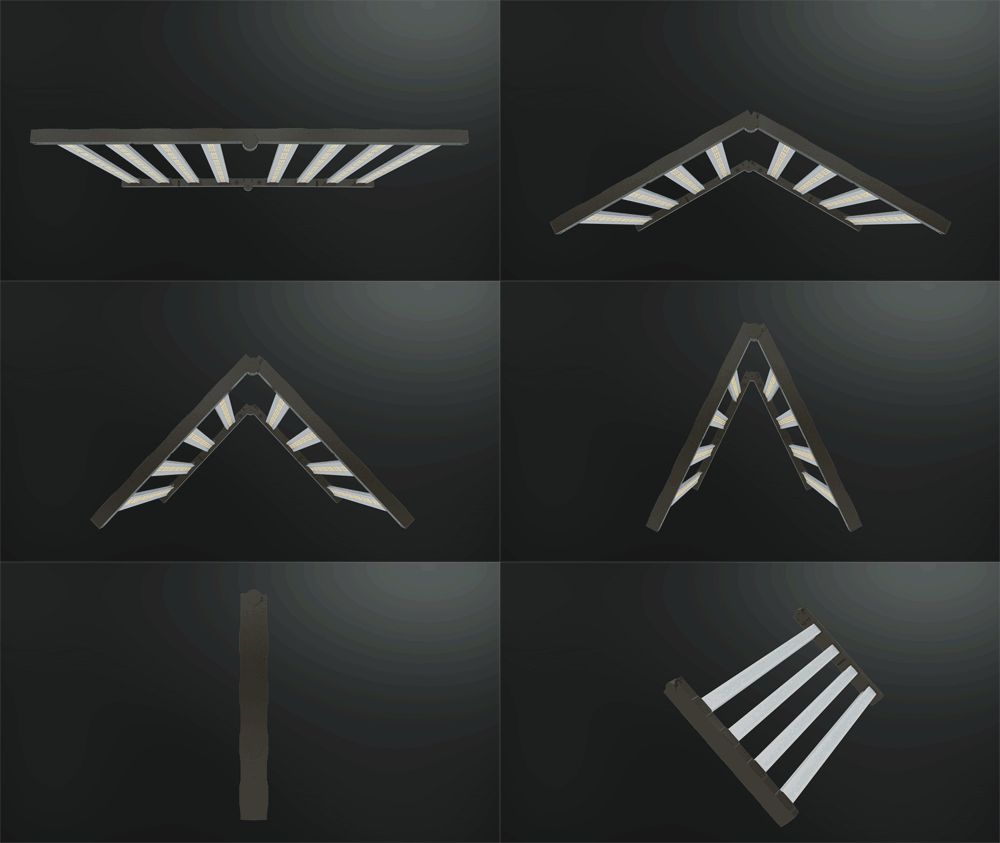
Heat output: To avoid leaves being burned, the best LED grow lights have cooling systems, such as radiators or rely on fans to dissipate heat, which can also keep the lamps from overheating.
Footprint map: The footprint map refers to the growth space of the plant light under different heights. This is measured in feet and usually falls between 2'✕2' and 4'✕4'.

Power: Contrary to popular belief, higher wattage is not the best way to assess how much power an LED light consumes. LEDs are designed to be cost-effective, so higher wattages may put more financial pressure on growers. The real measure of power comes down to how much light the plant itself needs to absorb, listed as a 400-700nm PAR rating. PAR stands for Photosynthetically Active Radiation, in other words, it is the amount of visible light that plants use for photosynthesis.
Light Intensity: Light intensity is measured in micromoles per joule. In product listings you'll see it written as umol/j or PPF (Photosynthetic Photon Flux). The best LED grow lights have a high PPF because they produce more photons per second. Look for lamps with 1.5 umol/j and above.
In addition to PPF, users may also see measurements of μmol/m2/s or PPFD (Photosynthetic Photon Flux Density). It sounds professional, but as a grower all you need to know is that PPFD measures the number of photons hitting the plant surface per second. You need to measure PPF and PPFD on the same plane at different heights to understand the intensity of light at different heights.

Voltage: Often overlooked by home growers, make sure the user's electrical outlet can accept the voltage range of your LED grow light, especially if the light fixture itself includes series functionality. This allows you to connect multiple lights in a given space, but consumes more power and requires wiring for home installations.
Warranty/Lifetime: Since LED grow lights are a product investment, having a warranty can effectively eliminate the worries of the user and ensure that faulty parts can be returned and replaced. Also, it is better to choose a product with a longer lifespan (more hours).
 Can ordinary LED lights be used as plant lights?
 The development trend of LED plant lights
 LED Grow Light Market Prospects
 The effect of photosynthesis on plants

Mobile official website