Introduction of core parameters of ED plant growth light:
Photosynthetic Active Radiation PAR (Photosynthetic Active Radiations
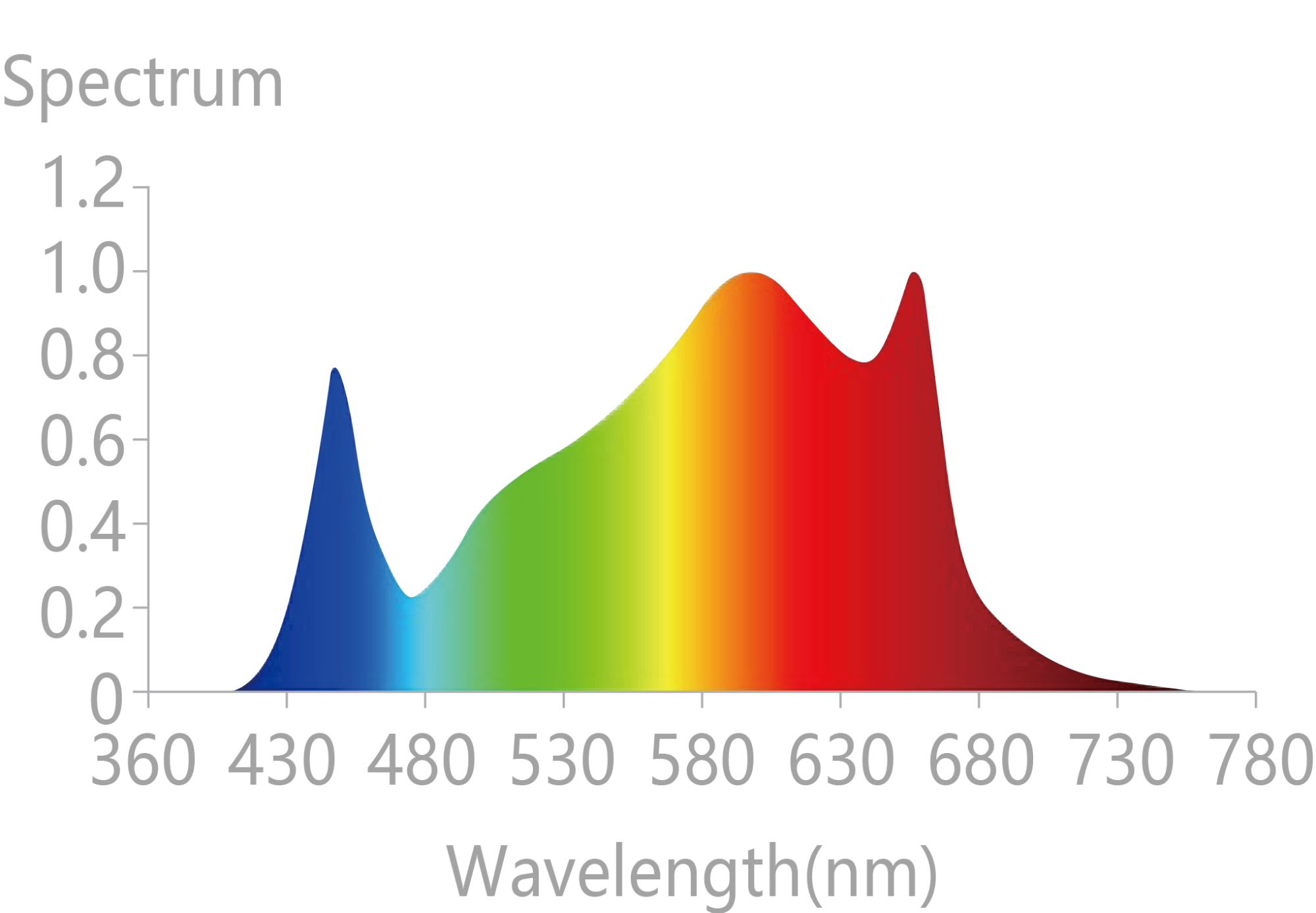
The radiation in the specific wavelength range (400-700nm) used by plants for photosynthesis is called photosynthetically active radiation, and there are two types of units: one is expressed by photosynthetic irradiance (w/m2), which is mainly used for the photosynthesis of sunlight. broad research. The second is expressed by photosynthetic photon flux density PPFD (umol/m2s), which is mainly used for the research of artificial light source and sunlight on plant photosynthesis. This method, which uses the photon flux radiated to the plant surface per second, expresses the radiation capacity of the radiation source, which is called the PPF_PAR method. PAR accounts for about 50% of the total solar radiation. It should be noted that the unit of photosynthetic irradiance does not reflect the influence of wavelength.

PPF:
Photosynthetic photon flux (Photosynthetic Photon Flux) refers to the number of micromoles of photons radiated by artificial light sources per second in the wavelength range of 400-700nm, in umol/s.
PPFD:
Photosynthetic Photon Flux Density (Photosynthetic Photon Flux Density) corresponds to PPF is the number of micromoles radiated by the light source per second per square meter, the unit is umol/m2s, which is the concept of density. PPFD is the PPF expressed in one square meter. PPFD is a physical quantity related to the radiation distance, which is inversely proportional to the square of the radiation distance. 1PPFD represents the number of photons per second 1 micromolar radiated on a surface of 1 square meter. How big is 1umol/m2s (PPFD), it means that there are 6 photons in 10 square nanometers.
YPF:
The generated photon flux (Yield Photon Flux) refers to the number of micromoles of photons radiated per second in the wavelength range emitted by artificial light sources, in umol/s. The generally considered band is 360-760nm, and for LED light sources, the wavelength range is set to 380-800nm.
YPFD:
The generated photon flux density (YieldPhotonFluxDensity), corresponding to YPF, is the number of micromoles of radiation per square meter per second, in umol/m2s, which is the concept of density.
YPFD is YPF expressed in one square meter.
YPFD is a physical quantity related to the radiation distance, which is inversely proportional to the square of the radiation distance.
YPFD can more accurately express the light quantity of LED plant light quality.
The difference between PAR and PPFD, PAR is a physical concept, and the unit of this physical concept of PPFD.
The relationship between PPFD and PPF: PPFD is the basic quantity derived from the planting process parameters, and PPF is the main parameter for lamp manufacturing
 Can ordinary LED lights be used as plant lights?
 The development trend of LED plant lights
 LED Grow Light Market Prospects
 The effect of photosynthesis on plants

Mobile official website